Article Console
Article-based scientific overview
The interface follows the study's core finding: fear conditioning changed emotional
and defensive behaviour, while prefrontal EEG differences appeared most clearly during
freezing episodes rather than as global or lateralised shifts.
01Behaviour
Emotional reactivity changed
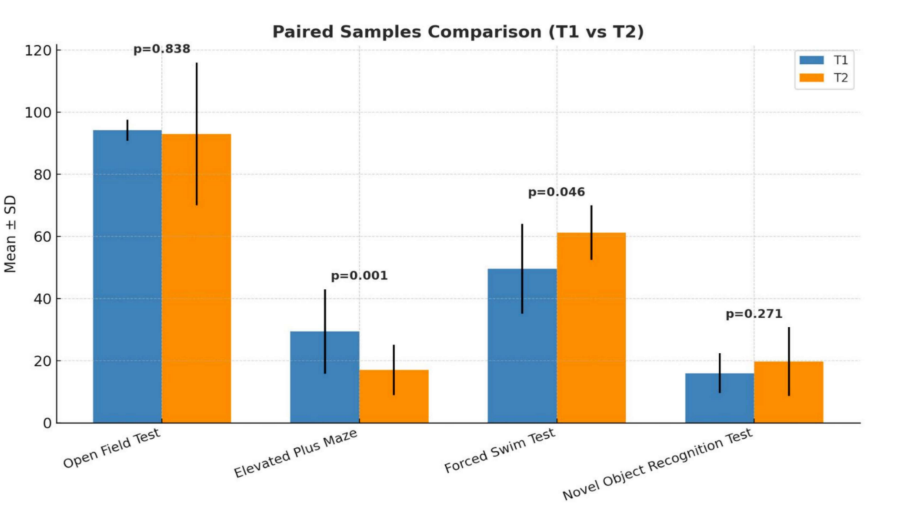
Conditioned rats spent less time in open arms of the Elevated Plus Maze and showed
more immobility during Forced Swim testing. Open Field and Novel Object Recognition
did not show significant changes.
02Prefrontal EEG
No global EEG shift
Comparisons before versus after aversive stimulation did not reveal significant
broadband prefrontal power changes. Left-right prefrontal comparisons also remained
non-significant.
03Freezing state
Broadband power increased
During freezing episodes, delta, theta, alpha, beta and gamma power all increased
significantly, suggesting state-dependent prefrontal modulation during defensive behaviour.
DomainSignificant article resultInterpretation used here
Elevated Plus MazeOpen-arm time decreased after conditioning.Anxiety-like behaviour increased.
Forced Swim TestImmobility increased after conditioning.Depression-like/passive coping behaviour increased.
OFT and NORNo significant effects were found.Exploratory and cognitive performance remained relatively preserved.
Freezing EEGAll measured frequency bands increased during freezing.Defensive behaviour carried the clearest prefrontal EEG signature.