
Emilia
Stet
Abstract:
First pages, including CFP for the next issue of the journal.











 ▲
▲

p-ISSN: 2068 - 0473
e-ISSN: 2067 - 3957
10.18662/brain
DOI prefix: 10.70594/brain (currently edited by EduSoft) | 10.18662/brain (when was edited by Lumen)
4 issues/year (occasional additional issues)
Web of Science (ESCI, IF 0.6), EBSCO, Google Scholar etc.
Member in CrossRef
CURRENT ISSUE 
LAST 2 PREVIOUS ISSUE
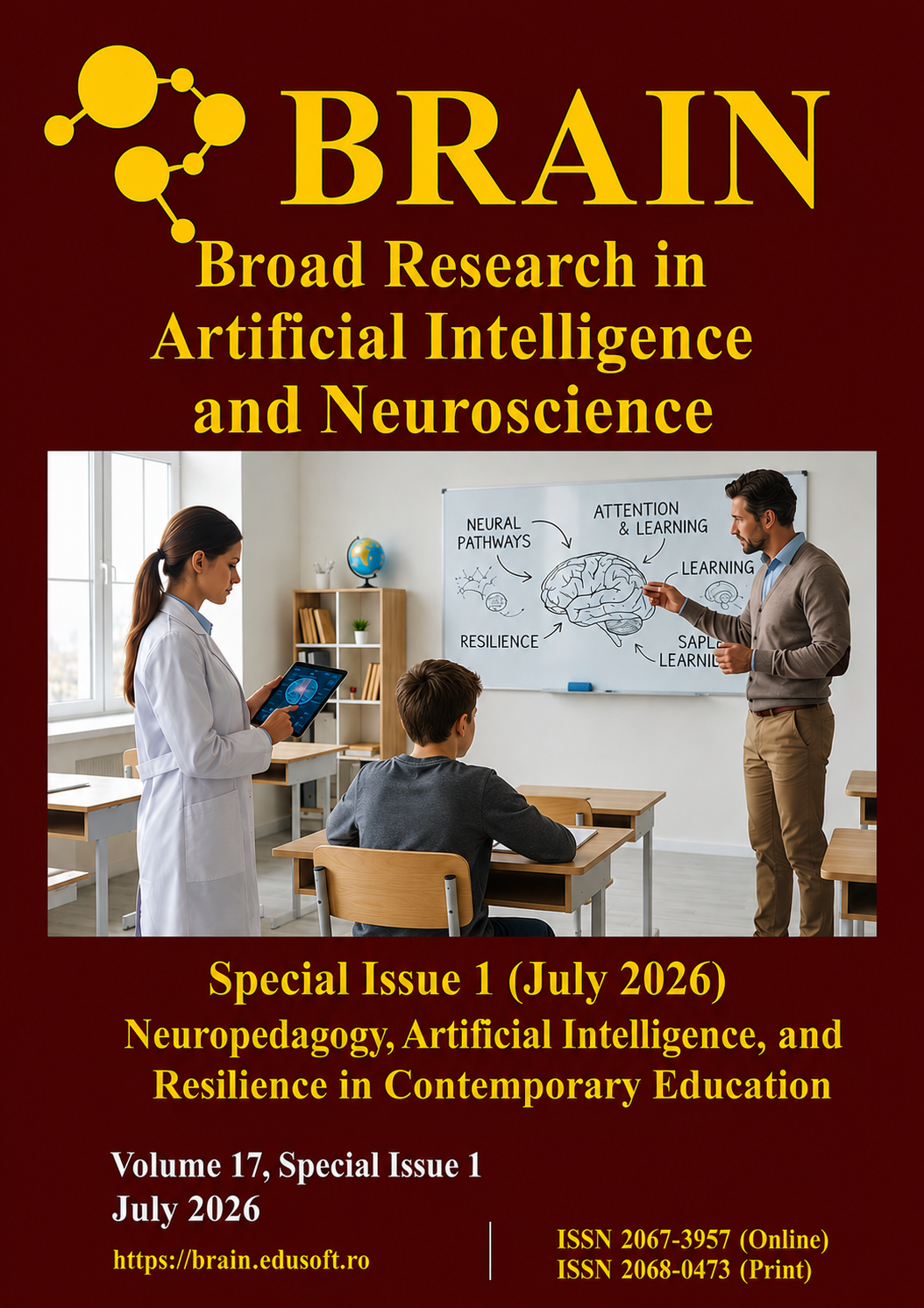



Disclaimer: These images were generated using artificial intelligence and may contain inaccuracies or inconsistencies. They are provided solely as a visual aid to facilitate the rapid understanding of the key ideas presented in these article. Our editorial team conducts ongoing reviews of AI-generated images and will correct or replace them whenever an error or discrepancy is identified or reported.

Disclaimer: This image was generated using artificial intelligence and may contain inaccuracies or inconsistencies. It is provided solely as a visual aid to facilitate the rapid understanding of the key ideas presented in this article. Our editorial team conducts ongoing reviews of AI-generated images and will correct or replace them whenever an error or discrepancy is identified or reported.
Authors:Face orientation recognition is an important topic in computer vision and pattern recognition. Due to the non-rigid properties of faces, it is computationally expensive and difficult to achieve good recognition accuracy and robustness in face orientation recognition. In this paper, we propose an image mapping technique for face analysis in smart camera networks with a feature extraction and data from the facial feature. We estimate the face orientation angles in all camera views, based on the matched imaged data. Our objective is to obtain a set of facial structures which can work as landmarks for tracking and recognition of facial expressions.

Disclaimer: This image was generated using artificial intelligence and may contain inaccuracies or inconsistencies. It is provided solely as a visual aid to facilitate the rapid understanding of the key ideas presented in this article. Our editorial team conducts ongoing reviews of AI-generated images and will correct or replace them whenever an error or discrepancy is identified or reported.
Authors:Making roads safer by avoiding road collisions is one of the main reasons for inventing Autonomous vehicles (AVs). In this context, designing agent-based collision avoidance components of AVs which truly represent human cognition and emotions look is a more feasible approach as agents can replace human drivers. However, to the best of our knowledge, very few human emotion and cognition-inspired agent-based studies have previously been conducted in this domain. Furthermore, these agent-based solutions have not been validated using any key validation technique. Keeping in view this lack of validation practices, we have selected state-of-the-art Emotion Enabled Cognitive Agent (EEC_Agent), which was proposed to avoid lateral collisions between semi-AVs. The architecture of EEC_Agent has been revised using Exploratory Agent Based Modeling (EABM) level of the Cognitive Agent Based Computing (CABC) framework and real-time fear emotion generation mechanism using the Ortony, Clore & Collins (OCC) model has also been introduced. Then the proposed fear generation mechanism has been validated using the Validated Agent Based Modeling level of CABC framework using a Virtual Overlay MultiAgent System (VOMAS). Extensive simulation and practical experiments demonstrate that the Enhanced EEC_Agent exhibits the capability to feel different levels of fear, according to different traffic situations and also needs a smaller Stopping Sight Distance (SSD) and Overtaking Sight Distance (OSD) as compared to human drivers.

Disclaimer: This image was generated using artificial intelligence and may contain inaccuracies or inconsistencies. It is provided solely as a visual aid to facilitate the rapid understanding of the key ideas presented in this article. Our editorial team conducts ongoing reviews of AI-generated images and will correct or replace them whenever an error or discrepancy is identified or reported.
Authors:E-learning includes forms of teaching supported by the Internet, computers, mobile devices, video tapes, and satellite TV. The term can apply both to out-of-classroom and in-classroom teaching. In recent years e-learning has become increasingly popular at universities around the world, because technology is a part of virtually every aspect of life. Rapid evolution of communication has changed language pedagogy and language use, enabling new forms of discourse and new ways to create and participate in communities (Kern 2006, 1). Under such circumstances it is important to explore new possibilities in teaching new topics and to give students a taste of new challenges. According to Blake (2008, 2) technology, if used wisely, could play a major role in enhancing L2 learners' contact with the other cultures and languages, especially in the absence of studying abroad. Traditional classes can become more interesting when combined with technology. Wong and Looi (2010, 14) claim that online-learning can fill in the gaps between formal learning styles. The present article presents the opinions and attitudes towards on-line set of courses for a sample of 80 Romanian students who were enrolled in an on-line learning project in "Area studies" - namely, East Asia Studies. The project covered two Academic years (2015 and 2016) and leads to the establishment of a virtual network of East European and Central Asia Universities on "Area Studies". At the end of each course students were asked to fill a short questionnaire about the online course they attend. The results of this small-scale survey showed both the positive character of using e-learning tools for teaching "Area Studies" and their limitations. At the same time, due to the length of the project (e.g. two years covered through different courses) the results allowed to make a comparison between two online platforms used during classes — Bluejeans and Cisco Webex — and to devise the ways of improving the future uses of online platforms during the next Academic year' courses.

Disclaimer: This image was generated using artificial intelligence and may contain inaccuracies or inconsistencies. It is provided solely as a visual aid to facilitate the rapid understanding of the key ideas presented in this article. Our editorial team conducts ongoing reviews of AI-generated images and will correct or replace them whenever an error or discrepancy is identified or reported.
Authors:Big data mining can lead to previously undiscovered links between genes, diseases, symptoms, drugs, etc. However, this mathematical correlation needs medical confirmation and that implies additional efforts of time, human and financial resources that are not always possible. Internet reviews, posts, hashtags can establish an informal corroboration tool, easily available. This paper explores the receptiveness towards a negative bias in health-related electronic Word of Mouth.

Disclaimer: This image was generated using artificial intelligence and may contain inaccuracies or inconsistencies. It is provided solely as a visual aid to facilitate the rapid understanding of the key ideas presented in this article. Our editorial team conducts ongoing reviews of AI-generated images and will correct or replace them whenever an error or discrepancy is identified or reported.
Authors:Cooperative learning has appeared as a new approach to teaching. This approach is utilized for small heterogeneous groups of students who cooperate to achieve a common goal. This study aimed at investigating the impact of cooperative learning on female medical students' happiness and social support. To this end, 72 female students of medicine at Shiraz Medical School were selected using cluster sampling and divided into experimental and control groups. The students were administered social support and happiness questionnaires as a pre-test. The same questionnaires were administered to them at the end of the term as a post-test. The students in the experimental group were taught to use cooperative learning strategies and the students in the control group followed the traditional approach. Data were analyzed using SPSS. The statistical procedures used for analyzing the data were mean, standard deviation, and multivariate analysis of covariance. The findings of the study indicated that cooperative learning had a significant impact on the level of happiness and social support of students compared to the conventional approach.

Disclaimer: This image was generated using artificial intelligence and may contain inaccuracies or inconsistencies. It is provided solely as a visual aid to facilitate the rapid understanding of the key ideas presented in this article. Our editorial team conducts ongoing reviews of AI-generated images and will correct or replace them whenever an error or discrepancy is identified or reported.
Authors:The quality of a finite product is influenced both on quantitative and qualitative factors and thus it is somewhat difficult to determine the major factors which affect it and their degree of influence. In this paper we present the usage of artificial intelligence (in particular artificial neural networks) in the development of an efficient research plan for studying the quality of finite products - in particular, wood briquettes obtained from various biomass mixtures.

Disclaimer: This image was generated using artificial intelligence and may contain inaccuracies or inconsistencies. It is provided solely as a visual aid to facilitate the rapid understanding of the key ideas presented in this article. Our editorial team conducts ongoing reviews of AI-generated images and will correct or replace them whenever an error or discrepancy is identified or reported.
Authors:
Disclaimer: This image was generated using artificial intelligence and may contain inaccuracies or inconsistencies. It is provided solely as a visual aid to facilitate the rapid understanding of the key ideas presented in this article. Our editorial team conducts ongoing reviews of AI-generated images and will correct or replace them whenever an error or discrepancy is identified or reported.
Authors:The e-commerce sites have many dimensions from the final user's point of view. Making websites more usable and improving the users' experience represents an important step when desiring to keep them from moving away. This study is examining the effects of the interactivity dimensions on users' content comprehension and their attitudes towards e-commerce websites. By using the eye tracking technology, we investigate the websites interactivity dimensions, identified in the interactivity index, exploring the visual process and drawing the time spent on the site or on various regions of it, the heatmaps, the scanpaths, the percentage fixated, the fixations before, the time to first fixation or the total fixation duration.

Disclaimer: This image was generated using artificial intelligence and may contain inaccuracies or inconsistencies. It is provided solely as a visual aid to facilitate the rapid understanding of the key ideas presented in this article. Our editorial team conducts ongoing reviews of AI-generated images and will correct or replace them whenever an error or discrepancy is identified or reported.
Authors:Massive Open Online Course (MOOC) paradigm has been growing in less than a decade from a life-long learning approach to a state-of-the-art method of offering a large plethora of courses and even specializations. Not only higher education, but also private companies started to manifest a growing interest into all the possibilities this technology is offering. This phenomenon received extra-consideration when renowned universities like Stanford, Harvard, École Polytechnique Fédérale de Lausanne, the Massachusetts Institute of Technology and Rice University started offering such courses. Embedded Systems field, on the other side, is one domain that continuously needs attention from educators. The concepts should be presented in a very friendly and approachable way, while in the same time preserving a practical, applicative vision. This paper presents a modality of integrating MOOCs into embedded systems higher education. The obtained results show that students prefer such a mix to the classical classroom methods of teaching.

Disclaimer: This image was generated using artificial intelligence and may contain inaccuracies or inconsistencies. It is provided solely as a visual aid to facilitate the rapid understanding of the key ideas presented in this article. Our editorial team conducts ongoing reviews of AI-generated images and will correct or replace them whenever an error or discrepancy is identified or reported.
Authors:Due to the fact that the abstract mathematical notions are often hard to grasp by students, without linking them to a specific physical representation or correlate them with regular facts, our team came up with the idea to create and implement a set of interactive teaching tool packages (ITTPs) to help them overcome such issues. The ITTPs consist of theoretical modules and applications in the framework of a Hungarian - Romanian cross-border project, developed with the aid of existing open source software and technologies. The focus of the Romanian team was on basic elements of linear algebra and analytic geometry, showcased using an auto-stereoscopic display for the purpose of image visualization. This paper presents an overview of similar technologies and the applications developed for representing pseudo-holographic images of geometric objects, namely vectors, straight lines, planes and conics. One of the developed packages was written using web technologies in order to make the applications available on mobile devices, as well as to eliminate the need to install any additional software.