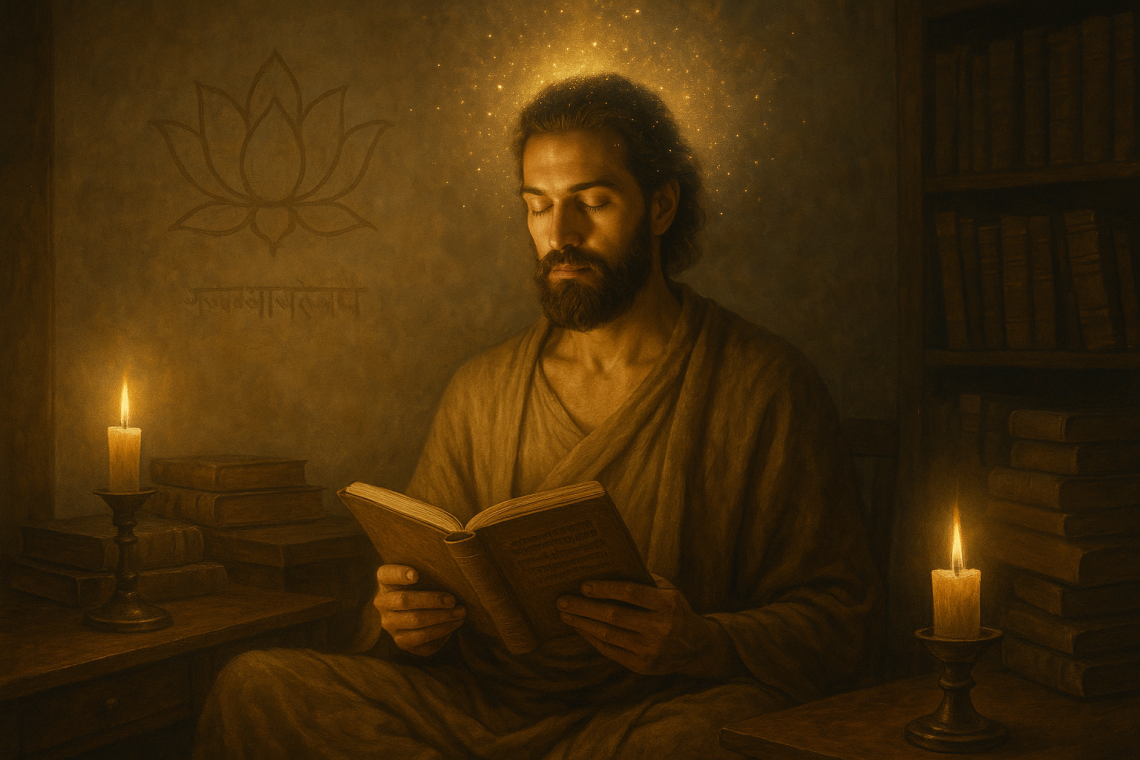
This post explores the philosophical and spiritual depth of yoga through the interpretive lens of Mircea Eliade — the Romanian historian of religions, philosopher, and scholar whose work profoundly influenced modern understandings of Eastern spirituality. The paper, authored by Marius Cucu and Oana Lența from “Ștefan cel Mare” University of Suceava, Romania, revisits Eliade’s view of yoga as a timeless path toward expanded consciousness and inner harmony.
Authors:
Marius Cucu – Lecturer, Ph.D., “Ștefan cel Mare” University of Suceava, Romania (RO)
Oana Lența – Associate Lecturer, Ph.D., “Ștefan cel Mare” University of Suceava, Romania (RO)
Introduction
In an age defined by distraction, anxiety, and digital overstimulation, the ancient discipline of yoga offers modern individuals a path to mental clarity and inner balance.
This paper, “Yoga and the States of Consciousness: A Perspective of M. Eliade on the Yoga Phenomenon,” examines Mircea Eliade’s philosophical and phenomenological interpretation of yoga, exploring how his ideas remain relevant to contemporary seekers of spiritual depth and psychological equilibrium.
The study revisits Eliade’s works such as “Yoga: Immortality and Freedom” and “The Myth of the Eternal Return”, illuminating how yoga, for Eliade, represents not only a physical or meditative practice, but a means of transcending ordinary consciousness and rediscovering the sacred dimension of existence.
Mircea Eliade’s Vision of Yoga
For Eliade, yoga is a science of the mind and spirit — a disciplined method of reintegration through which the practitioner seeks to escape the conditioned human state and reach supraconscious experience (samadhi).
He regarded yoga as:
- A technique of spiritual liberation (moksha), not merely a moral or religious doctrine;
- A systematic exploration of consciousness, mapping the inner layers of human experience;
- A universal path of transformation, transcending cultural and historical boundaries.
By studying Patañjali’s Yoga-Sūtra alongside tantric and meditative traditions, Eliade emphasized that yoga provides a methodology for self-realization — a process of overcoming the illusion of separateness and reconnecting with the cosmic consciousness.
Hindu Metaphysics and Yogic Foundations
The authors analyze the Hindu metaphysical principles underlying the yoga tradition — concepts such as prakṛti (nature), puruṣa (pure consciousness), ātman (the Self), and karma (the moral law of action and consequence).
They distinguish between:
- Yoga-Sūtra (Classical Yoga) — a structured, ascetic approach emphasizing control of the mind, detachment, and meditation;
- Secondary yogic typologies — devotional (bhakti), knowledge-based (jnāna), and action-oriented (karma) paths that offer alternative routes toward liberation.
Eliade’s interpretation situates these practices not only within religious systems, but as experiments in consciousness, anticipating modern psychological and neuroscientific approaches to meditation.
Yoga as a Journey Through the States of Consciousness
Drawing from Eliade’s phenomenology of religion, the paper presents yoga as a dynamic path through altered states of consciousness — from sensory awareness to deep meditative absorption.
In Eliade’s terms, each stage of yoga corresponds to a progressive withdrawal from temporal existence, culminating in a state of unity between the individual and the absolute.
Modern researchers now echo these insights through studies on:
- Neuroplasticity and meditation,
- Theta and gamma brainwave synchronization, and
- Mind-body coherence during mindfulness and pranayama practices.
Thus, Eliade’s vision — once rooted in mythological and spiritual analysis — finds validation in contemporary neuroscience, linking ancient introspection with modern cognitive science.
The Contemporary Relevance of Eliade’s Thought
Cucu and Lența highlight how Eliade’s approach to yoga remains profoundly relevant today.
His writings encourage the modern individual—often fragmented by materialism and technology—to rediscover:
- Inner silence as a form of resistance to existential chaos;
- Meditation as a journey inward, restoring connection to the sacred;
- Conscious awareness as a path toward psychological integration and freedom.
Eliade’s insights invite contemporary readers to treat yoga not simply as physical exercise, but as a discipline of consciousness, a path to self-knowledge, and a means of restoring wholeness in a disoriented world.
Conclusion
The study reaffirms Mircea Eliade’s lasting influence in understanding yoga as a bridge between ancient metaphysics and modern psychology.
Through his phenomenological lens, yoga emerges as both a spiritual science and an existential therapy, capable of transforming human consciousness and reconnecting it with its transcendent source.
By revisiting Eliade’s interpretation, the authors invite educators, philosophers, and practitioners alike to view yoga not only as an art of meditation but as a living philosophy of consciousness and liberation.
See full paper here: https://brain.edusoft.ro/index.php/brain/article/view/1243.

