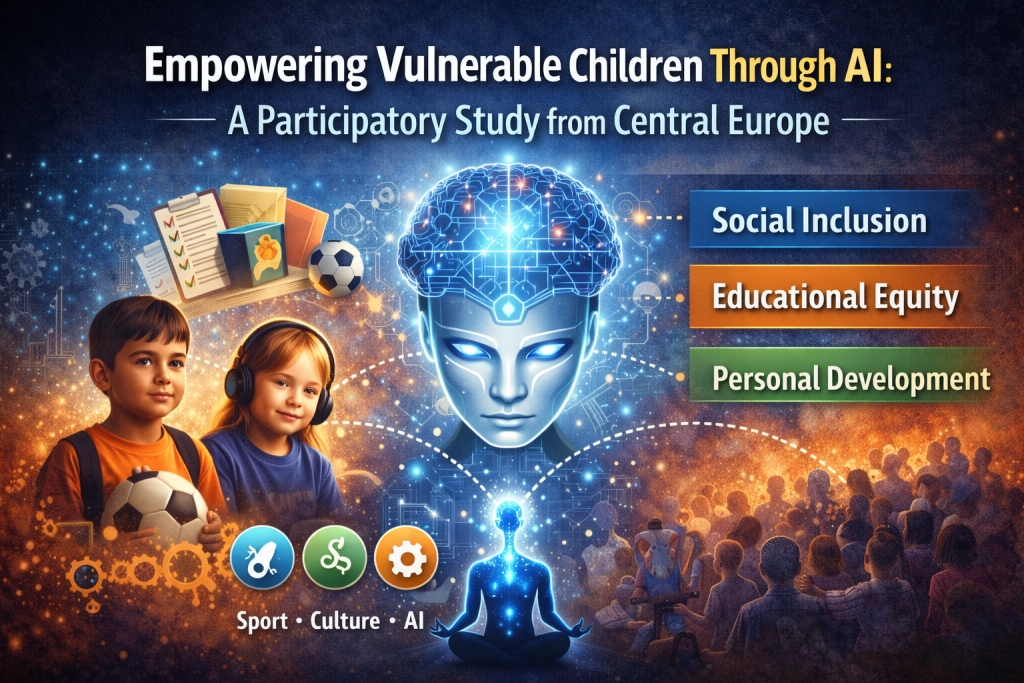
Empowering Vulnerable Children Through AI: A Participatory Study from Central Europe
Children living in residential childcare institutions worldwide face significant barriers to social inclusion, personal development, and educational equity. This article reports findings from the international project Sport, Culture, and Education: Empowering Visegrad’s Children for a Brighter Future, which integrating non-formal education, cultural expression, and sports to foster inclusion and 21st-century competencies among children in residential childcare.
An important innovation of the project was the integrative use of artificial intelligence (AI) to support pedagogical planning, adaptive content creation, and participatory evaluation processes. Employing a participatory action research design and mixed methods, the study involved 68 children from residential childcare institutions in the Czech Republic, Slovakia, and Ukraine, accompanied by 21 childcare professionals.
Results show that AI has significantly enhanced the quality and individualisation of educational and cultural interventions, while also improving the efficiency of data collection and analysis. At the same time, our study highlights critical ethical, linguistic, and contextual challenges to the deployment of AI in these vulnerable populations. The article discusses the broader implications of AI in the context of residential childcare. It presents evidence-based recommendations for educators, not only in residential childcare settings but also those seeking to employ AI responsibly and effectively in the fields of child welfare and inclusive education.