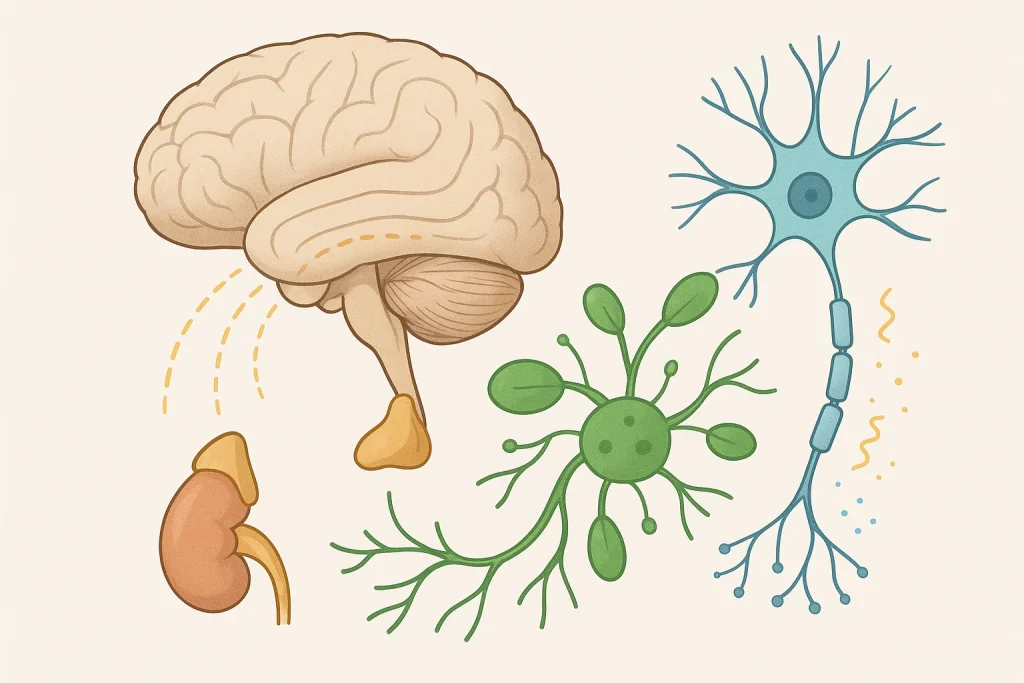
The Brain’s Essential Role in Mediating Immune Responses: HPA Axis to Leverage Signals with a Systemic Approach
This paper investigates the brain’s pivotal role in coordinating and mediating immune responses, emphasizing the integrative function of the hypothalamic–pituitary–adrenal (HPA) axis. Although the influence of various brain regions on immune modulation is widely acknowledged, the underlying neuroimmune pathways remain complex and insufficiently understood. Traditional animal knockout models often fail to capture the full spectrum of human biological and psychological factors, creating a gap in translational neuroscience.
To address this challenge, the study introduces a computational neuroscience approach designed to federate diverse experimental data and biological signals, including neuro-endocrine, lymphatic, and neuro-electrical components. Using a hierarchical HPA axis model as the central analytical framework, it demonstrates how previous results obtained from murine models can be re-evaluated through advanced in silico human modeling. This systemic computational schema provides a new avenue for exploring neuroimmune interactions, offering deeper insight into how brain-mediated signaling influences immune responses in humans.ining neuro-endocrine, lymphatic, and neuro-electrical data to understand neuroimmune mechanisms in humans.
See full paper here: http://dx.doi.org/10.70594/brain/15.4/25