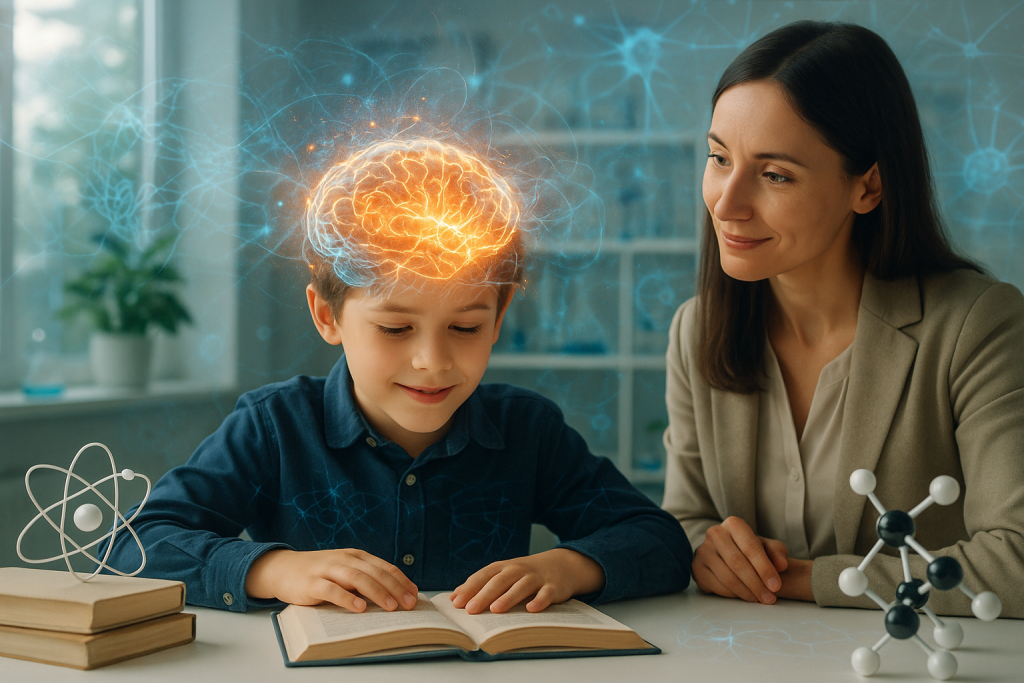
Detection of Intellectual Giftedness in Children of Different Ages and Methods of Its Development as an Aspect of Neurophysiological Development
This article presents a comprehensive study on how intellectual giftedness manifests across different childhood stages and how neurophysiological mechanisms contribute to its identification and development. Authored by an interdisciplinary team of Ukrainian researchers, the study bridges educational psychology, neuroscience, and pedagogy to establish more effective methods for diagnosing and nurturing gifted children.
Authors:
Iryna Pidlypniak – Candidate of Pedagogical Sciences, Associate Professor, Senior Lecturer, Department of Psychology and Pedagogy of Child Development, Pavlo Tychyna Uman State Pedagogical University, Ukraine (UA)
Oksana Marchuk – Doctor of Science in Pedagogy, Associate Professor, Professor, Department of General Pedagogy and Preschool Education, Academician Stepan Demianchuk International University of Economics and Humanities, Ukraine (UA)
Victoriia Naichuk – Doctoral Student, Department of Psychology, Candidate of Psychological Sciences, H.S. Skovoroda Kharkiv National Pedagogical University, Ukraine (UA)
Olena Tryfonova – Doctor of Science in Pedagogy, Full Professor, Department of Primary and Preschool Education, V.O. Sukhomlynskyi Mykolaiv National University, Ukraine (UA)
Inokentii Korniienko – Doctor of Science in Psychology, Full Professor, Department of Psychology, Mukachevo State University, Ukraine (UA)
Svitlana Mashchak – Associate Professor of Psychology, Candidate of Psychological Sciences, Lviv Polytechnic National University, Ukraine (UA)
Introduction
The concept of giftedness—its origins, definitions, and practical implications—has fascinated educators and philosophers for centuries. From the reflections of Plato and Confucius to the frameworks of modern cognitive science, the question remains: What makes a child gifted, and how can we nurture such potential effectively?
This study, “Detection of Intellectual Giftedness in Children of Different Ages and Methods of Its Development as an Aspect of Neurophysiological Development,” explores giftedness not only as a set of observable traits but as a neurophysiological phenomenon—a product of complex interactions between brain development, environment, and educational influence.
Purpose of the Study
The research aims to:
- Identify the neurophysiological and psychological foundations of intellectual giftedness in children of various ages;
- Clarify the types and characteristics of giftedness and its developmental dynamics;
- Develop effective diagnostic tools for recognizing intellectual giftedness;
- Propose methods for supporting and cultivating these abilities through neurophysiological and pedagogical approaches.
Theoretical Foundations
Giftedness is conceptualized as a unique combination of cognitive, creative, and neurobiological traits that allows an individual to achieve exceptional results in a specific field.
According to the authors, intellectual giftedness arises from:
- Genetic predispositions influencing neural connectivity and brain plasticity;
- Environmental stimulation that strengthens neural pathways related to problem-solving and creativity;
- Motivational and emotional regulation, which sustain learning curiosity and cognitive engagement.
Historically, thinkers such as Plato viewed giftedness as a divine quality, while Confucius emphasized discipline and moral cultivation. Modern neuroscience, however, explains giftedness as a synergy of cognitive processing speed, synaptic efficiency, and hemispheric balance, making it a measurable and developable quality.
Methods
The study employed:
- Theoretical analysis and synthesis of educational, psychological, and neurophysiological literature;
- Comparative evaluation of diagnostic frameworks used internationally for identifying giftedness;
- Development of an integrated model linking pedagogical assessment with neurophysiological indicators (attention, memory, problem-solving speed, emotional regulation).
Through this multi-method approach, the researchers sought to unify psychological theory with biological evidence, aligning giftedness research with current findings in neuroeducation.
Key Findings
- Giftedness as a Neurophysiological Process
Intellectual giftedness stems from the brain’s enhanced ability to process, integrate, and apply information. It involves efficient activation of prefrontal and parietal regions, superior working memory capacity, and heightened creative association patterns. - Types of Giftedness
- Cognitive giftedness – high analytical and logical reasoning abilities;
- Creative giftedness – originality, divergent thinking, and imagination;
- Academic giftedness – mastery of complex information in specific domains;
- Social-emotional giftedness – empathy, leadership, and advanced interpersonal understanding.
- Diagnosis and Evaluation
Effective detection of giftedness requires multidimensional assessment, combining:- Neuropsychological observation (attention span, response time, emotional control);
- Behavioral indicators (curiosity, persistence, independence);
- Pedagogical evaluation (learning pace, adaptability, innovative thinking).
- Methods for Development
- Differentiated instruction and enrichment programs tailored to cognitive strengths;
- Neurodevelopmental exercises improving memory, executive function, and focus;
- Creative problem-solving workshops encouraging flexible thought;
- Emotional intelligence training for balanced self-regulation and motivation.
Discussion
The authors emphasize that giftedness should not be treated as elitism, but as a responsibility — both for educators and society. Early recognition and appropriate support can prevent underachievement and social isolation often observed in gifted children.
By adopting a neurophysiological approach, education systems can move beyond surface-level academic metrics toward a deeper understanding of how gifted minds learn, think, and feel.
This perspective highlights that giftedness is not static — it can be nurtured and strengthened through targeted cognitive and emotional development.
Conclusion
The study concludes that intellectual giftedness represents a unique neurophysiological configuration — an integration of biological predispositions, cognitive processes, and psychosocial conditions.
Identifying and developing giftedness requires a holistic model that unites neuroscience, pedagogy, and psychology. The proposed diagnostic and developmental methods offer a pathway for educators to recognize potential early, guide it effectively, and ensure that gifted children reach both their intellectual and emotional maturity.
Such an approach contributes not only to individual fulfillment but also to societal innovation and progress, making the study of giftedness a key concern in contemporary education and neuropsychology.
See full article here: https://doi.org/10.18662/brain/14.1/418.